
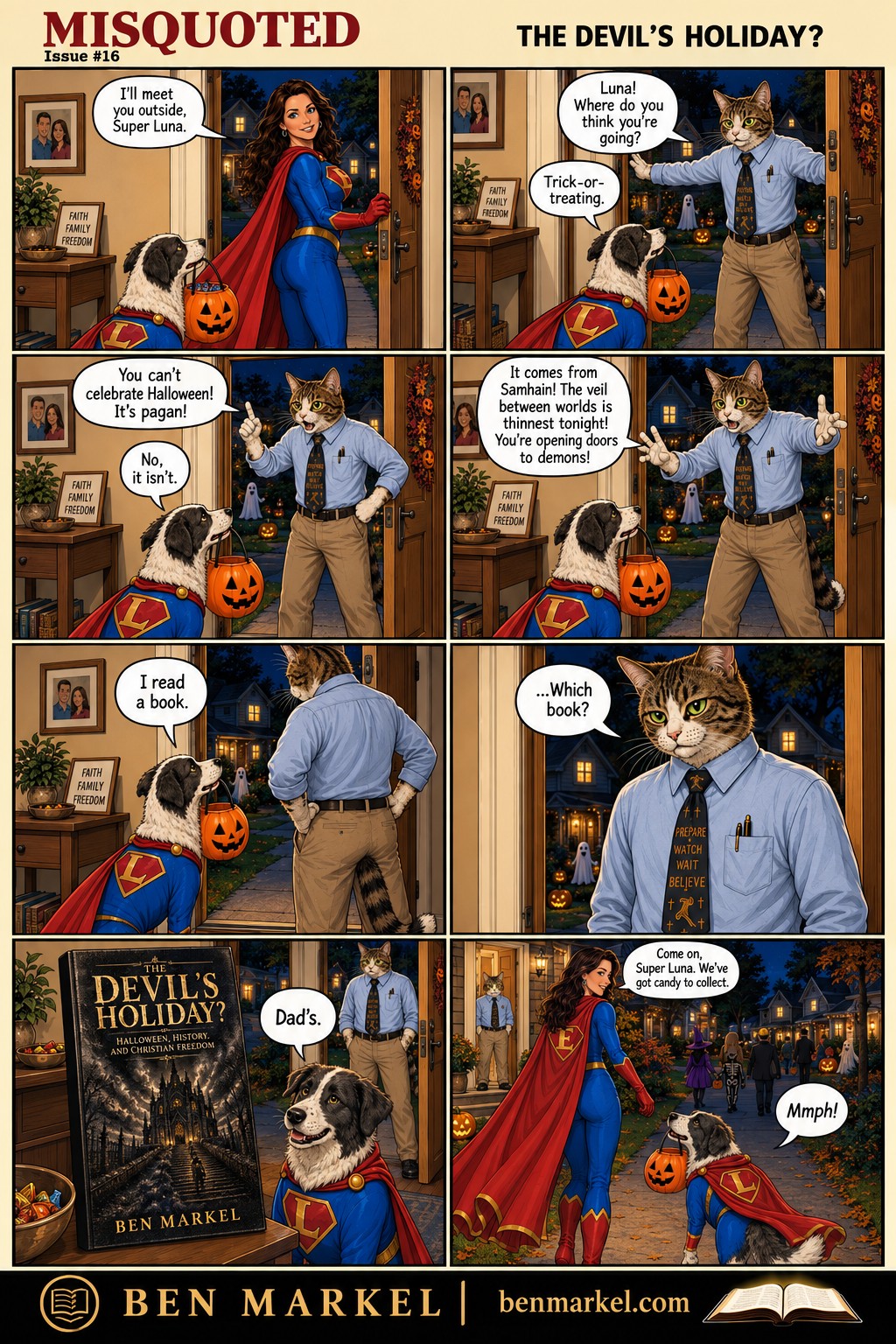
Every October, Christians hear familiar warnings about Halloween. It is described as a pagan holiday derived from Samhain, an ancient Celtic festival during which the boundary between the living and the dead supposedly became thin. Costumes are said to have originated as disguises intended to deceive wandering spirits, while modern Halloween decorations, horror movies, and even participation in trick-or-treating may be described as opening spiritual doors. The conclusion is that Christians who participate in Halloween, regardless of their intentions, are unknowingly participating in practices whose spiritual meaning was established centuries ago.
There are pieces of genuine history behind some of those claims, but they are frequently combined with later folklore, historical reconstruction, and theological assumptions. Once those different categories are collapsed together, a supposed historical origin can easily become a moral prohibition without anyone first demonstrating that Scripture actually prohibits the activity.
What Was Samhain?
Samhain was a real Irish seasonal festival associated with the beginning of winter. Medieval Irish literature presents it as an important occasion for gatherings and feasting, and it also contains genuine supernatural associations. Stories set at Samhain include encounters with the dead, otherworldly beings, danger, and passage into another world. Those associations are part of the historical record and should not be erased simply because some modern claims about Samhain have been exaggerated.
The difficulty begins when that evidence is expanded into a complete ancient religious system that the surviving sources do not provide. The historical record does not establish one standardized Celtic religion in which all Celtic peoples observed October 31 as a religious New Year’s Eve while a literal spiritual barrier surrounding the world became thinner. Neither was Samhain originally the name of a god or demon.
The familiar modern picture developed gradually. Medieval traditions were supplemented by later folklore, eighteenth-century antiquarians attempted to reconstruct the religion underlying those traditions, and Victorian scholars developed broader theories concerning ancient Celtic religion. Popular writers subsequently inherited many of those conclusions while often abandoning the qualifications that originally accompanied them. Over time, historically distinct ideas could be compressed into a single account and presented as a straightforward description of what “the Celts believed.”
Recognizing that development does not require denying Samhain’s genuine supernatural associations. It requires distinguishing what the historical sources actually establish from what later generations reconstructed from them.
Halloween Has More Than One History
Describing Halloween simply as Samhain under another name creates another historical problem because the name Halloween did not come from Samhain at all. It developed from All Hallows’ Eve, the evening preceding All Hallows’ Day, or All Saints’ Day. All Hallows’ Even gradually contracted into Hallowe’en and eventually became the modern word Halloween.
That Christian etymology does not establish that every practice now associated with Halloween originated within Christianity. It demonstrates instead why attempting to classify the entire holiday as either pagan or Christian oversimplifies its development. Samhain had its own history, Hallowtide had another, and customs involving disguises, house-to-house visiting, seasonal celebrations, frightening imagery, food, and entertainment developed and changed across different cultures and periods.
Modern Halloween is therefore not one ancient religious ceremony preserved unchanged into the present. It is a collection of practices with different histories that eventually became associated with the same date and celebration. Establishing that some element of that history was once connected with pagan religion still would not, by itself, answer the Christian moral question. Scripture requires us to distinguish between something having a historical association with paganism and someone presently participating in pagan worship.
Origin and Participation Are Not the Same
Paul provides an important example of that distinction in 1 Corinthians 8–10. He treats pagan worship as spiritually serious and explicitly forbids Christians from participating in the table of demons. At the same time, he permits Christians to purchase meat from the ordinary marketplace without investigating whether it had previously been sacrificed to an idol. He likewise permits eating food served in an unbeliever’s home unless circumstances give the act a specifically religious or conscientious significance.
Paul can maintain both positions because an object’s religious history does not permanently determine the meaning of every subsequent use. Participation in pagan worship is forbidden, while something that once existed within a pagan setting may later possess an ordinary use. The controlling issue is not genealogy alone but what the Christian is actually doing, what the action presently means, and whether it involves religious allegiance or participation.
Paul grounds this distinction in the declaration that “the earth is Yahweh’s, with its fullness” (1 Corinthians 10:26). Pagan worshipers can misuse created things, but their misuse does not transfer ownership of creation to pagan gods or demons. Seasons, food, material objects, and the calendar remain part of God’s creation even when human beings employ them in rebellion against him.
This means that even a demonstrated pagan origin would not automatically establish that every later use of a custom constitutes pagan worship. Historical origin can be relevant, particularly when it affects what an action presently communicates, but origin and participation remain different categories.
Scripture Still Establishes Real Boundaries
Rejecting guilt by historical association does not require treating every Halloween activity as morally neutral. Scripture explicitly condemns idolatry, divination, sorcery, and attempts to consult the dead. Those practices do not become permissible because they are performed recreationally or because they occur during Halloween.
A Christian participating in an actual Pagan Samhain ritual is therefore doing something fundamentally different from a family taking children trick-or-treating on the same evening. Likewise, attempting to contact spirits through a séance is different from watching a fictional depiction of one. The relevant distinction is not simply that both activities occur on October 31 or share similar imagery. One actually performs the religious or occult practice Scripture prohibits, while the other does not.
Modern Satanists can also attach religious significance to Halloween, and Christian participation in Satanic worship would obviously be incompatible with allegiance to Christ. That does not mean Satanists acquire ownership of every unrelated activity occurring on the same date. The existence of Satanic religious observance on October 31 cannot transform an ordinary activity into Satanic worship merely through chronological proximity.
The Christian question must therefore remain focused upon the activity itself. If someone is actually practicing idolatry, divination, sorcery, necromancy, or false worship, Scripture has already supplied the prohibition. There is no need to construct a questionable historical argument in order to condemn something God has directly forbidden.
Can Halloween “Open Spiritual Doors”?
The claim that Halloween objects or activities can “open doors” to demons raises a different question because it proposes an actual spiritual mechanism. Costumes, decorations, horror movies, occult imagery, or objects previously connected with sinful practices may be said to grant demons access or provide them with some form of spiritual right.
Scripture certainly gives Christians reason to take demons and occult practices seriously. It records the destruction of idolatrous and magical objects and repeatedly condemns participation in false worship. An object can have genuine religious significance because of what someone is doing with it, and repentance from an occult practice may appropriately involve abandoning objects through which that practice was performed.
What Scripture does not provide is a general doctrine in which material objects acquire persistent demonic contamination merely through association. It does not teach that wearing a fictional witch costume automatically opens a spiritual door, that watching a horror movie creates a demonic legal right, or that an unknowingly purchased object transfers the spiritual allegiances of its previous owner to its new one.
This distinction leaves room for genuine Christian discernment without creating a system Scripture never establishes. A believer may conclude that certain entertainment is spiritually unhealthy, parents may establish boundaries concerning costumes or decorations, and someone leaving occult practices may wisely remove objects strongly connected with his former life. A Christian may also abstain from Halloween entirely as a matter of conscience. None of those decisions requires believing that demons obtain access through costumes, pumpkins, decorations, or fictional representations of darkness.
Can a Christian Celebrate Halloween?
A Christian can celebrate Halloween, and another Christian can abstain from it. Neither conclusion eliminates the responsibility to evaluate what a person is actually doing.
If an activity constitutes idolatry, divination, sorcery, necromancy, or false worship, the Christian should reject it because Scripture rejects it. If participation violates a believer’s conscience, that believer should abstain. If exercising a legitimate freedom would harm another believer or communicate religious allegiance that the Christian does not intend, love and wisdom may provide good reasons not to exercise that freedom.
What Christians should not do is convert a historical association into a universal biblical prohibition. Saying that a practice has some relationship to pagan history is not equivalent to demonstrating that a Christian performing a modern activity is participating in pagan worship. The first is a historical claim. The second is a moral and theological claim, and it requires its own argument. The tendency to collapse those categories allows historical connections to become moral prohibitions and personal convictions to become commands imposed upon everyone else.
Christians should take demons, idolatry, and occult practices seriously precisely because Scripture takes them seriously. That same commitment requires us to let Scripture define the boundaries rather than supplementing them with a system built from uncertain history, inherited assumptions, or fear.